Your brand isn’t ranking.
It’s not even being cited.
AI search has rewritten the rules. ChatGPT, Perplexity, Gemini, and Claude aren’t just answering questions — they’re deciding who gets recommended. We make sure that’s you.
Get a free AI visibility audit
Last updated August 2026
What is AI search visibility?
AI search visibility is how often — and how accurately — AI tools like ChatGPT, Perplexity, Gemini, and Google’s AI Overviews mention, cite, or recommend your brand when people ask questions in your space. It’s the AI-era equivalent of a first-page ranking, except the answer engine picks one or two names instead of showing ten links.
Two terms cover the work of improving it, and people use them almost interchangeably:
Answer Engine Optimization
Structuring your content so answer engines can find it, extract it, and quote it — direct answers, clean headings, FAQ blocks, and structured data that machines parse without guessing.
Generative Engine Optimization
The broader discipline of shaping how generative AI describes and recommends your brand — your own content, plus the third-party reviews, publisher mentions, and community discussions AI engines treat as evidence.
How it differs from SEO: SEO gets you ranked. AEO gets you cited. Good SEO is still the foundation — AI engines draw heavily on search indexes — but ranking alone no longer guarantees you’re in the answer. A well-structured page can be cited even when it doesn’t rank first.
| Traditional SEO | AEO / GEO | |
|---|---|---|
| You win when | You rank on page one | The AI names you in its answer |
| Unit of competition | A page | A passage — one clear, liftable answer |
| Who’s judging | Google’s ranking systems | ChatGPT, Perplexity, Gemini, AI Overviews |
| What earns trust | Links and authority | Sources, statistics, structure, third-party consensus |
| How you measure it | Rankings and organic traffic | Share of voice inside AI answers |
| When it compounds | Months of link building | Structure moves in weeks; citations build for the long term |
SEO alone won’t save you.
Search has changed. If your strategy was built for Google circa 2023, you’re losing ground in the world of AI chatbots and answer engines.
Review and comparison sites took your rankings.
A new layer of editorial sites now dominates SERPs, sitting between your brand and the audiences searching for you. They capture the click, shape opinion, and own the visibility you used to.
AI Overviews push you off the page.
Even when you rank, the AI Overview appears above your result, and most people never scroll past it. Position #1 is less valuable than it’s ever been.
Audiences are using AI, even within Google.
People increasingly turn to ChatGPT, Gemini, Claude, and Google’s AI Overviews to research products, services, organizations, and ideas. If you’re not being cited in those answers, you don’t exist.
You have no visibility into any of it.
Traditional GA4 and Search Console data doesn’t show you how AI engines are (or aren’t) recommending you. You’re flying blind.
How AI engines decide who to recommend
This isn’t guesswork. The selection patterns are studied, and they’re consistent. Princeton’s GEO research (presented at KDD 2024, tested on Perplexity) measured what actually moves AI visibility:
Structure gets extracted. AI engines lift passages, not pages. Content with clear direct answers, comparison tables, and FAQ blocks gets pulled into answers; content that buries its point in paragraph five doesn’t.
Third parties carry more weight than your own site. AI engines lean on the sources they trust: review platforms, industry directories, publisher coverage, Wikipedia, Reddit. Brands are several times more likely to be cited through third-party sources than through their own domains — which is why citation building is half of this work, not an add-on.
Freshness matters. Dated, recently-updated content beats undated content of the same quality. AI engines want to hand people current answers.
Every one of those is a lever you can pull. That’s the program.
What changes when you show up.
The brands moving now are being recommended in answers their competitors don’t even know exist.
Capture high-intent audiences first.
Reach the people who never make it to your website. Be the brand AI recommends when intent is highest.
Beat competitors to market.
Appear in AI recommendations while competitors remain invisible in traditional search.
Build category authority.
Become the cited expert AI engines reference when people ask questions in your space.
Clear deliverables. Measurable results.
Strategy and measurement. Authoritative content. Third-party citations. Technical foundations. Four pillars that together make you the brand AI engines recommend.
AEO Strategy & AI Visibility Tracking
We define the strategic direction for your AI visibility program and track how it’s performing. That means measuring how AI engines describe, cite, and recommend you across platforms, benchmarking against competitors, and analyzing what the data means and what to do about it.
Content Strategy & Creation
We produce the accurate, well-sourced, expert-backed content that AI engines recognize as reliable and cite back to users. That includes refreshing existing content with current thinking, adding authoritative references like studies and expert commentary, and building the topic depth that signals authority.
Authority & Citation Building
AI builds its picture of your brand from everywhere you appear, not just your website. We secure the publisher placements, review-site presence, third-party citations, and Reddit visibility that LLMs treat as authoritative. The goal is consistent, credible signals everywhere AI looks.
Site & Technical AEO
We make your site and content extractable, understandable, and credible to AI. Clear heading hierarchies, FAQ and summary blocks, structured data and schema, entity and knowledge graph optimization, and the E-E-A-T signals (Experience, Expertise, Authority, Trust) AI engines reward. Many of these overlap with technical SEO, and we cover both.
We run this playbook on our own site.
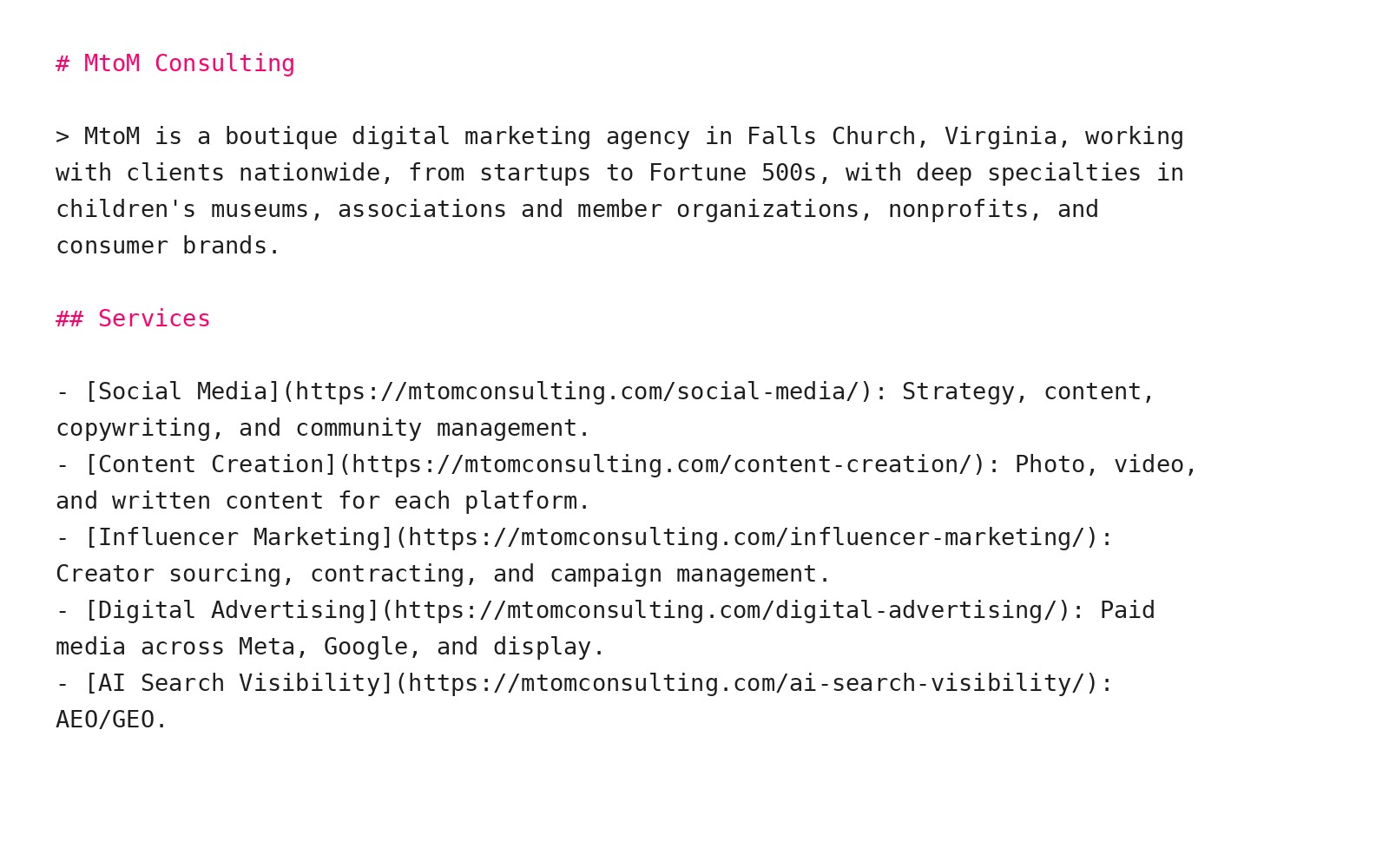
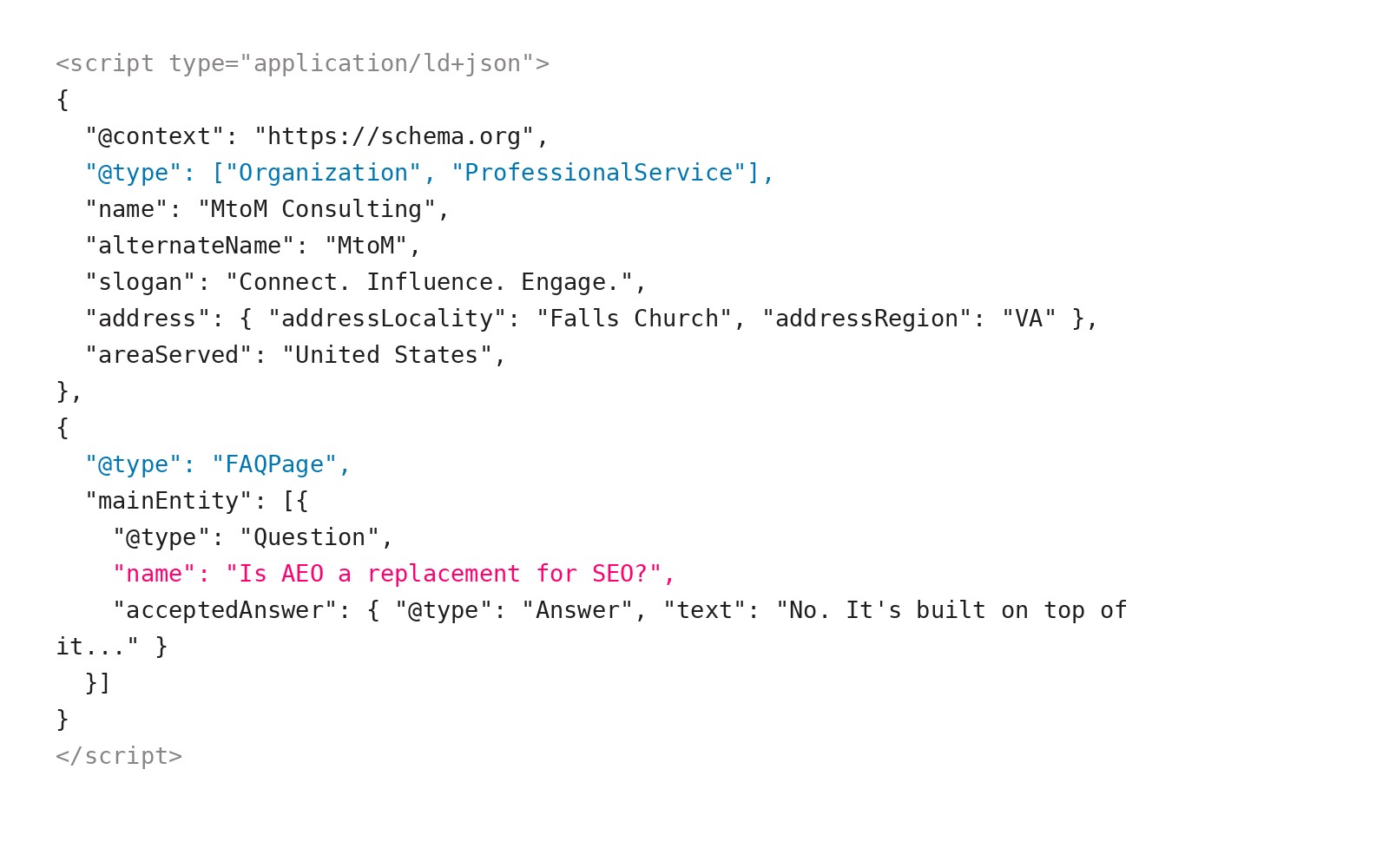
In August 2026 we audited mtomconsulting.com the way we’d audit a client — and then did the work. Structured data describing who we are and what we do, so engines don’t have to guess. An llms.txt file that gives AI systems a clean, machine-readable map of the agency. FAQ blocks written the way real clients ask real questions, marked up so answer engines can lift them whole. Direct-answer definitions at the top of pages instead of buried in paragraph five.
We track the results the same way we would for you: which queries surface us in ChatGPT, Perplexity, and Google’s AI answers, and how that changes month over month.
Ask us on the discovery call and we’ll show you the actual implementation — the schema, the tracking, the answers. It’s easier to trust a mechanic who maintains their own car.
Where this matters most
AI visibility isn’t equally urgent for everyone. It matters most where buyers research before they commit — and that’s exactly where our clients live.
Museums & attractions
Parents ask ChatGPT what to do with kids this weekend, and trip planners ask it what’s worth visiting. The institutions AI names get the visit; the rest depend on someone scrolling. We already market for children’s museums day to day, so we know which questions families actually ask.
Associations & nonprofits
When someone asks an AI who the authority is on your issue, the answer should be your organization. Associations have a structural advantage here: AI engines favor exactly the kind of authoritative, member-backed expertise you already produce. The work is making it visible.
Consumer brands
Product research is moving into AI conversations, and recommendations there arrive with borrowed trust — one name, not ten blue links. If review sites and Reddit threads are shaping how AI describes your product, that’s either an asset you’re managing or a liability you haven’t seen yet.
If your buyers ask questions before they spend money, this applies to you. The audit tells you how much.
How an engagement works
We run your brand through the queries that matter to your business across ChatGPT, Perplexity, Gemini, and Google AI Overviews, and audit your site’s extractability — schema, structure, freshness, and the third-party sources AI already associates with you. You get the findings whether or not you go further.
Technical AEO first, because it’s fast and it compounds: schema, FAQ blocks, direct answers, llms.txt. Then the slower, more durable work — content depth and third-party citations — in priority order from the audit.
AI share of voice, brand attribute tracking, citation performance, and traditional SEO in one report. What happened, why, and what we’re doing about it next month.
Finally, AI visibility you can actually measure.
Reporting tells you what’s happening. Analysis tells you why. Insights tell you what to do next. We deliver all three.
AI Share of Voice
Track how often your brand is recommended by ChatGPT, Gemini, Claude, and Google AI Overviews, and how that compares to every competitor.
Brand Attribute Analysis
See exactly how AI engines describe your brand versus competitors (pricing, coverage, trust, reviews) and identify gaps in your positioning.
Content & Citation Performance
Know which of your pages are being cited by AI, which topics they trust, and where you need to build new content authority.
Traditional SEO & Traffic Tracking
Organic traffic, keyword trends, publisher placement performance, and paid search and social results. The full picture.
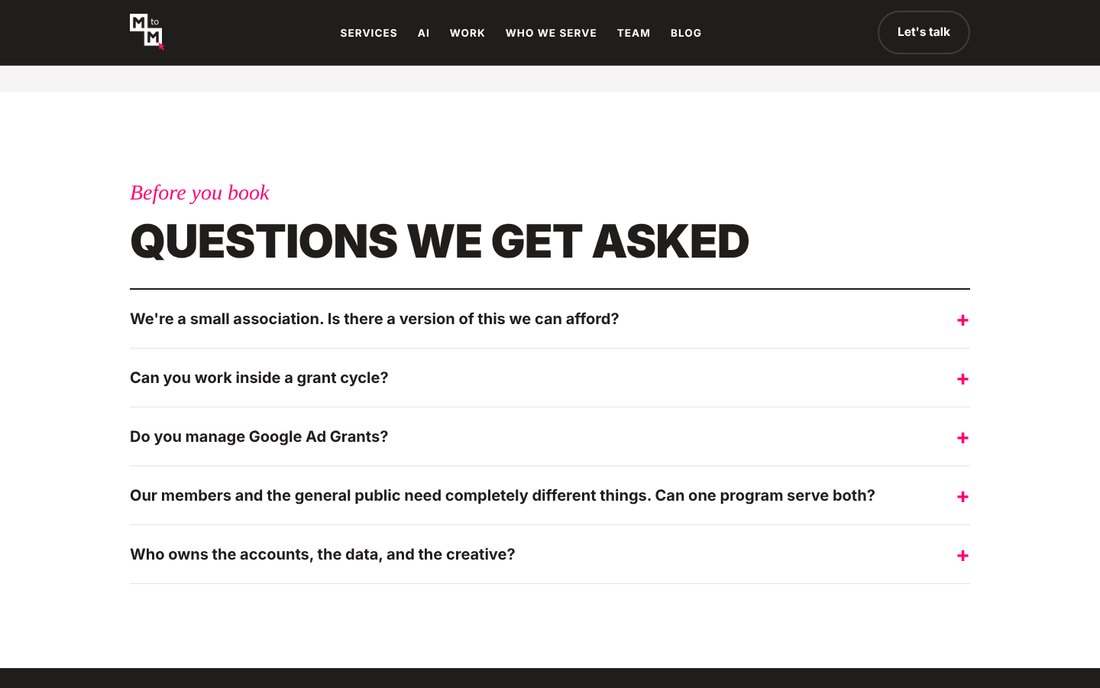
Questions we get asked
Is AEO a replacement for SEO?
No — it’s built on top of it. AI engines draw on search indexes, so a site that’s invisible to Google is invisible to them too. The mistake is stopping at SEO: ranking gets you onto the list AI engines read, and AEO is what gets you into the answer they write.
How do you measure what an AI says about us?
We build a panel of the queries that matter to your business and run them on a schedule across ChatGPT, Perplexity, Gemini, and Google AI Overviews — logging whether you’re cited, who is, how you’re described, and how that shifts month to month. It’s the same discipline as rank tracking, applied to answers instead of positions.
How long until we see results?
The technical layer moves first — schema, structure, and direct answers get picked up as engines recrawl, often within weeks. Citations and third-party authority build over months, and they’re what make the results durable. We report monthly from day one, so you see the movement as it happens rather than waiting for a big reveal.
Will optimizing for AI hurt our regular Google rankings?
No. Nearly everything AI engines reward — clear structure, direct answers, cited sources, real expertise — is what Google’s own quality guidelines have asked for all along. Done right, the same work improves both. What does hurt is the old-school shortcut: research shows keyword stuffing actively reduces AI visibility.
We’re a small organization. Is there a version of this we can afford?
Yes. Every engagement starts with the audit, and for some clients the audit plus a one-time technical fix is the whole project. Retainers are for brands competing in categories where AI answers are already steering buyers.
Do you actually do this to your own site?
We do — schema, llms.txt, extractable answers, and monthly AI visibility tracking on mtomconsulting.com. Ask on the discovery call and we’ll walk you through the implementation itself, not a slide about it.
Find out what AI says about your brand.
Most brands have never once checked. The audit is free, the findings are yours either way, and the ones who look first tend to stay ahead.
Get a free AI visibility audit
Prefer email? Send us a brief.